What Is UAE E-Invoicing?
UAE e-invoicing is a structured electronic invoicing system that enables invoice data to be issued and exchanged electronically between a supplier and a buyer and reported electronically to the UAE Federal Tax Authority.
An eInvoice is not simply a normal invoice saved as a PDF or sent by email. The UAE Ministry of Finance explains that PDF files, Word documents, images, scanned copies and emails are not considered eInvoices because they are not structured electronic invoice data.
How Does UAE E-Invoicing Work?
The UAE e-invoicing framework uses the international OpenPeppol standard. This provides a standardized way for businesses and government entities to exchange electronic invoice information through approved service providers.
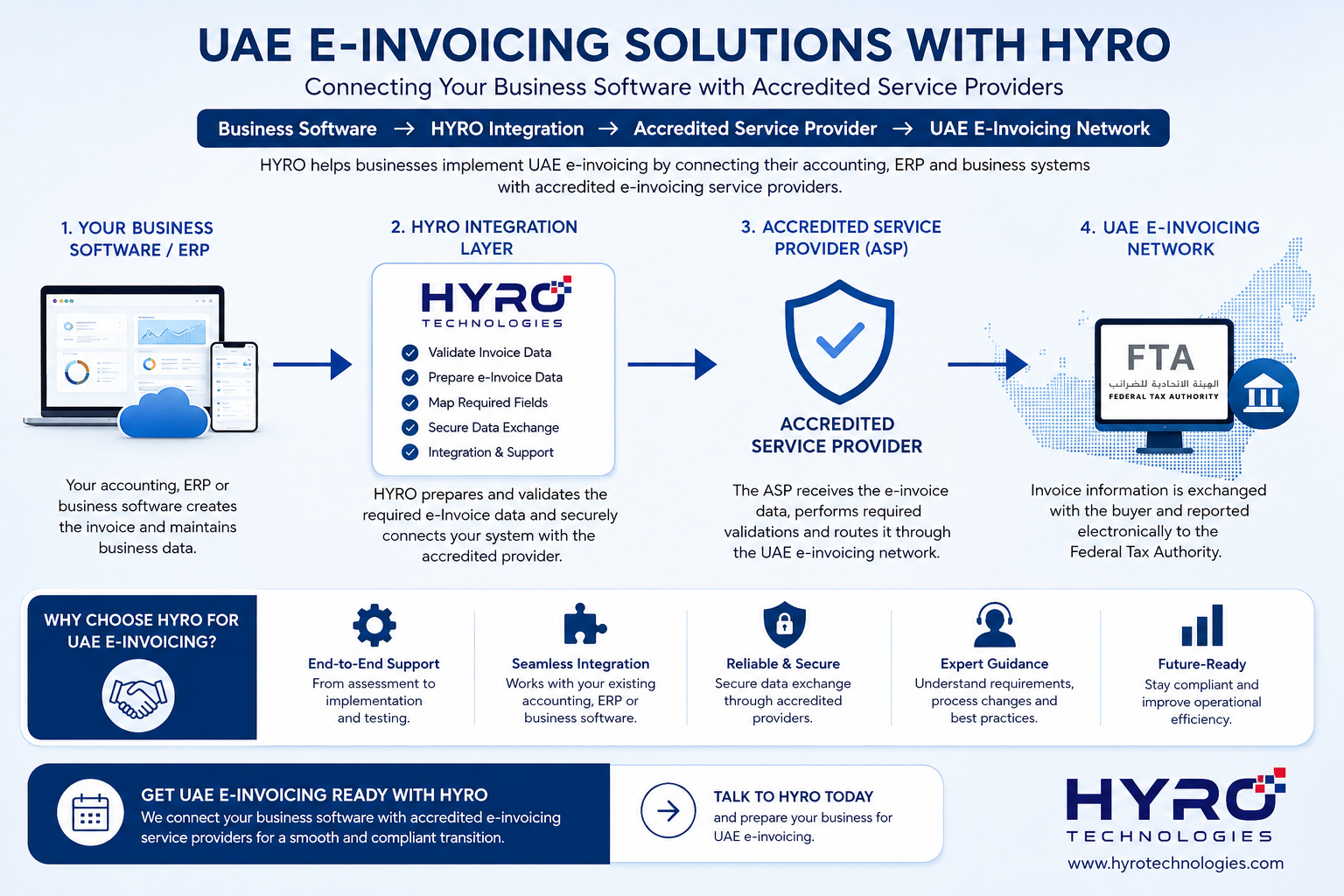
A simplified business flow can be understood like this:
- Your accounting, ERP or business software creates the invoice.
- The required structured invoice data is prepared by your system.
- The data is sent through an Accredited Service Provider.
- The invoice information is exchanged with the buyer through the e-invoicing network.
- Required invoice information is electronically reported to the Federal Tax Authority.
This means businesses should not think only about choosing an ASP. They should also make sure their existing accounting or ERP system can generate and provide all the required e-invoice information.
What Is an Accredited Service Provider?
An Accredited Service Provider, commonly referred to as an ASP, is a service provider officially accredited to operate as an e-invoicing service provider under the UAE e-invoicing framework.
Businesses that fall within the implementation requirements need to appoint an Accredited Service Provider according to the applicable implementation timeline.
The Ministry of Finance publishes and periodically updates the official list of Accredited Service Providers.
How HYRO Can Help with UAE E-Invoicing
HYRO Technologies helps businesses prepare and implement UAE e-invoicing by connecting their accounting, ERP and business software with accredited e-invoicing service providers.
Instead of treating e-invoicing as a completely separate system, HYRO focuses on making the required e-invoice process work with the software businesses already use for sales, customers, VAT, accounting and ERP operations.
Depending on the customer's existing software and requirements, HYRO can assist with:
- Reviewing the existing accounting or ERP invoicing workflow
- Checking whether required invoice data is available
- Preparing software for e-invoice data integration
- Connecting the business system with an Accredited Service Provider
- Supporting integration testing and implementation
- Helping businesses understand the operational changes required for e-invoicing
UAE E-Invoicing Implementation Deadlines
The UAE is introducing mandatory e-invoicing in phases. The applicable timeline depends mainly on the annual revenue of the business.
Businesses with annual revenue of AED 50 million or more
- Appoint an Accredited Service Provider by 30 October 2026.
- Mandatory e-invoicing implementation from 1 January 2027.
Businesses with annual revenue below AED 50 million
- Appoint an Accredited Service Provider by 31 March 2027.
- Mandatory e-invoicing implementation from 1 July 2027.
Government entities
Government entities also have a phased implementation timeline under the UAE e-invoicing framework.
Why Your Accounting or ERP System Matters
An Accredited Service Provider handles an important part of the e-invoicing exchange, but the quality and completeness of the invoice data still depend on the business system that creates the invoice.
Businesses should therefore review whether their accounting, ERP or POS software can maintain and provide the data required for electronic invoicing.
This may include information relating to:
- Seller details
- Buyer details
- Invoice number and date
- Tax registration information
- Products or services
- Quantity and pricing
- Discount information
- Tax information
- Invoice totals
- Payment and reference information where applicable
The exact mandatory data requirements should be checked against the latest UAE e-invoicing specifications.
For a practical software readiness process, read our UAE E-Invoicing Software Preparation Guide to understand how ERP, accounting, POS and existing business systems can be prepared for integration.
How Should Businesses Prepare for UAE E-Invoicing?
Businesses should avoid waiting until the mandatory implementation date. The transition may require changes to master data, invoice fields, software integrations and internal processes.
1. Review your existing invoicing software
Check how invoices are currently generated and where seller, customer, tax and transaction information is stored.
2. Review customer and company master data
Incomplete or inconsistent business information can create problems when invoice data must be exchanged electronically.
3. Identify missing invoice fields
Compare your existing invoice structure with the official UAE e-invoicing mandatory field requirements.
4. Select an Accredited Service Provider
Review approved providers and choose a solution that fits your business, software environment and implementation requirements.
5. Plan ERP or accounting integration
Determine how your invoicing software will send and receive the required information through the chosen ASP.
6. Test before mandatory implementation
Testing gives your business time to identify missing data, integration issues and operational changes before the applicable deadline.
Which Businesses Should Start Preparing?
Any business that falls within the UAE e-invoicing scope should understand how the new framework affects its invoicing processes.
This includes businesses using:
- Accounting software
- ERP systems
- Retail and POS software
- Restaurant and cafe software
- Gym management software
- Spa and salon software
- Garage and workshop software
- Custom business applications
The technical implementation may vary between systems, but the core requirement remains the same: the business must be able to provide correct structured invoice data through the required e-invoicing process.
Why E-Invoicing Is More Than a Compliance Requirement
Although regulatory compliance is the immediate reason businesses are preparing for e-invoicing, structured invoice data can also improve the overall quality of financial processes.
Potential operational benefits include:
- Less manual invoice data entry
- More consistent invoice information
- Faster electronic document exchange
- Better integration between business systems
- Improved traceability
- Reduced dependence on paper or unstructured invoice formats
UAE E-Invoicing Readiness Checklist
Businesses can start with this simple readiness checklist:
- Is your company information complete and accurate?
- Are customer tax and contact details maintained properly?
- Does your invoice contain the required data fields?
- Can your ERP or accounting software extract structured invoice data?
- Have you reviewed the current Accredited Service Provider list?
- Do you know your applicable implementation deadline?
- Have you planned the integration between your software and ASP?
- Have you allocated time for testing?
Get UAE E-Invoicing Ready with HYRO Technologies
HYRO Technologies works with businesses using accounting, ERP and other business management software to prepare their systems for UAE e-invoicing.
Our approach is to connect the business software layer with an Accredited Service Provider so customers can manage the transition through a practical implementation path.
Whether you already use HYRO software or need help connecting an existing business system, talk to our team about your UAE e-invoicing requirements.
Prepare Your Business for UAE E-Invoicing
Talk to HYRO about your current accounting, ERP or invoicing system and how it can be prepared for integration with an Accredited Service Provider.